
The Case for IP Is Bigger Than C-Band
The Upper C-band transition is forcing content owners to rethink their distribution strategy. I think the more useful question is what you’d build today if you started from where audiences, platforms and monetization are actually headed.
By Chris Myers
September 2026
There has been a lot of discussion lately about the Upper C-band transition and what it means for broadcasters and content owners. Satellite alternatives, IP distribution, hybrid approaches, reimbursement options and replacement technologies are all part of the conversation.
That’s an important conversation, but I think there is a risk that we focus too much on what replaces C-band and miss the bigger opportunity.
For content owners facing a transition, the question shouldn’t simply be, “What should I replace my satellite distribution with?”
The better question is: If I were designing my content distribution strategy today, based on where audiences, platforms and monetization are going, what would I build?
For me, that leads pretty quickly to IP.
The case for IP isn’t that satellite is bad
I have spent a large part of my career working with satellite distribution, and it has been an incredibly effective technology. It remains very good at what it was designed to do: reliably distribute high-quality video to a large number of destinations across a wide geographic area.
So I don’t believe content owners should move to IP simply because satellite is “old,” because of rain fade, or because there may be reimbursement dollars available to help pay for the transition.
I believe they should move toward IP because their content needs to do more.
Over the years, I’ve been involved in a number of large-scale transitions from satellite to IP distribution. What has always interested me most is what happens after the transition.
Once you stop thinking about IP simply as a replacement transport and start thinking about what an IP-based distribution architecture can enable, the conversation changes.
A single source can support multiple destinations with different requirements. One platform may need a particular bitrate or format. Another may require different metadata. Another may need specific ad signaling. Content can be versioned for different regions, languages or platforms. New destinations can be added without rebuilding the entire distribution model around them.
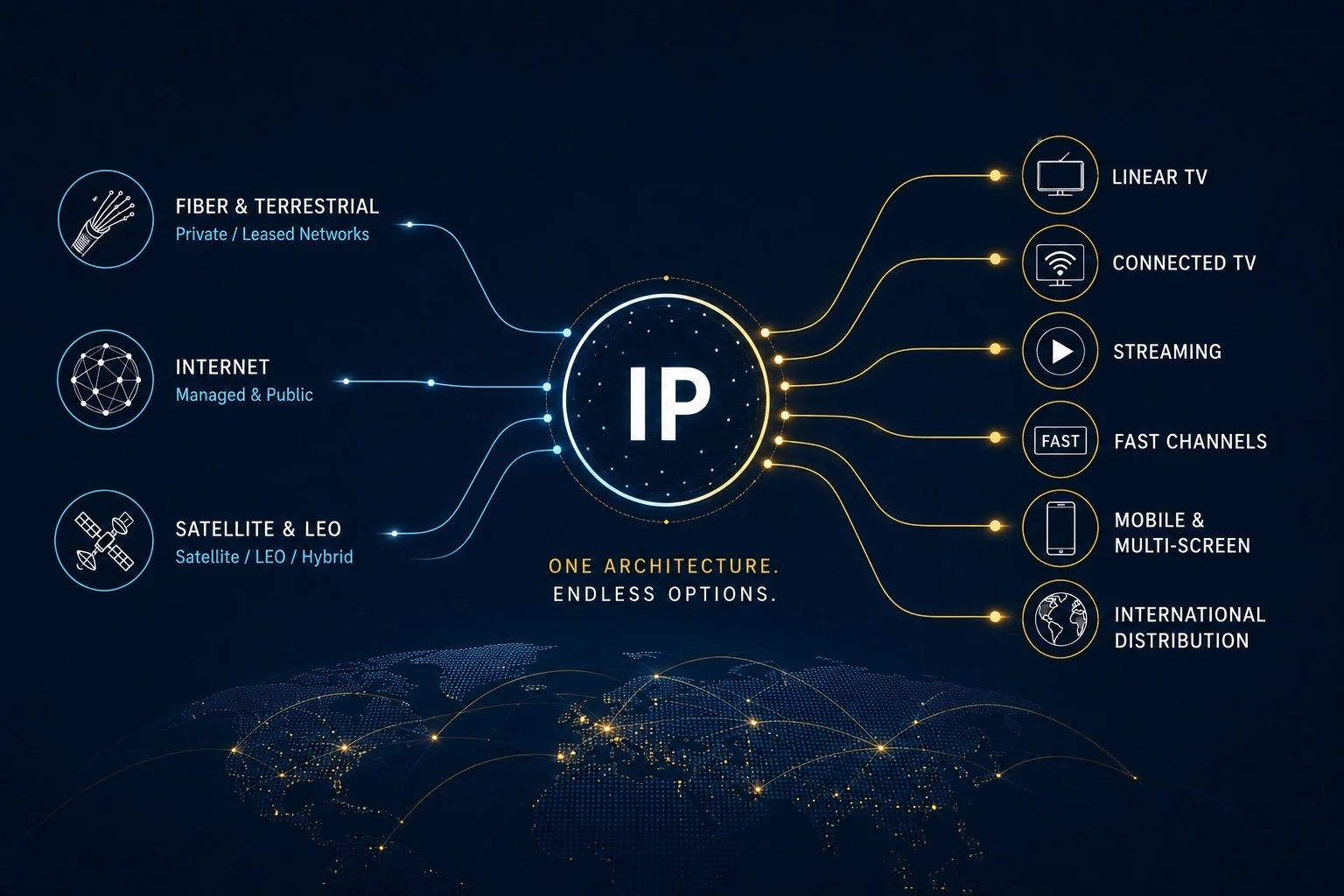
The same content may ultimately need to reach traditional linear television, connected TV, streaming platforms, FAST channels, mobile devices, international partners and destinations that may not even exist today.
That is a very different distribution problem than the one satellite was originally built to solve.
The audience and the money are moving
This isn’t just a technology discussion.
According to the Interactive Advertising Bureau, U.S. digital video advertising is projected to surpass $80 billion in 2026 and account for more than 60 percent of total U.S. TV and video advertising spending for the first time.
EMARKETER is projecting another interesting milestone this year. U.S. connected TV upfront advertising spending is expected to reach $17.73 billion, surpassing primetime linear TV upfront spending of $16.98 billion for the first time.
None of this means linear television is going away. It isn’t. There is still an enormous audience and a significant amount of money in traditional television.
But the direction is pretty clear. Audiences and advertising dollars increasingly span both traditional and digital platforms.
If that’s where the business is going, distribution infrastructure needs to be able to support it.
And this is where I think the case for IP becomes much more interesting than a simple satellite replacement discussion.
IP creates options
The real value of an IP distribution architecture is flexibility.
It gives content owners the ability to think beyond moving a channel from Point A to Point B.
How quickly can I launch on a new platform? Can I support both traditional linear and digital distribution from the same underlying infrastructure? Can I add a new version or a new destination without rebuilding the chain around it?
Those questions are increasingly tied directly to revenue.
If a new distribution opportunity appears, the technology shouldn’t be the reason you can’t pursue it.
I’ve seen firsthand what happens when content owners begin taking advantage of this flexibility. The initial project may have been about replacing an existing distribution path, but the real value comes from the new things the architecture allows them to do afterward.
That, to me, is the much stronger business case for IP.
Satellite and IP are converging
There is another reason I think the traditional satellite versus IP discussion is becoming less useful.
The line between the two is getting harder to draw.
For years, one of the strongest arguments for satellite distribution was reach. What about rural areas? What about locations where reliable broadband isn’t available? What about places where building terrestrial connectivity is simply too difficult or too expensive?
Those are legitimate questions. But the answers are changing, and it’s worth being precise about what kind of satellite we’re talking about. Traditional satellite video distribution, including the C-band capacity at the center of this discussion, has long been used to deliver video efficiently to receive sites across a wide geographic area. What’s happening now with LEO satellite networks is a different application: they’re delivering IP connectivity, essentially broadband, to places where terrestrial broadband has historically been difficult, expensive or unavailable. Starlink is already doing it at scale, and Amazon is building out its own LEO satellite network.
I’m writing this from New York City, where I pay a significant amount every month for my Internet connection. Meanwhile, someone in rural America can now install a small satellite terminal and get high-speed IP connectivity that would have been hard to imagine not very long ago.
Think about what that means for the traditional satellite versus IP debate.
Satellite isn’t disappearing. In many ways, it’s becoming part of the IP network, and LEO broadband is strengthening IP’s reach rather than competing with it.
As these networks continue to grow, the question increasingly isn’t satellite or IP. It’s how satellite, fiber, managed networks, the public Internet and other forms of connectivity work together as part of an IP-based distribution architecture.
I think that’s a much more interesting way to look at where video distribution is going.
Start with your requirements, not somebody else’s solution
There are a lot of very good technology companies offering solutions to the market right now. They have different strengths, different architectures and different approaches to solving the problem.
That’s healthy.
But every vendor is naturally going to look at the transition through the lens of what they sell.
Content owners have to start somewhere else.
Before deciding on a platform or provider, start with what you need your content distribution operation to accomplish.
Where does your content need to go today? Where might it need to go tomorrow? How many versions could you need? What formats do you need to support? What are your metadata and advertising requirements? What level of reliability and redundancy does the business require? How quickly do you need to add a new destination? And just as importantly, how much control do you want over all of it?
Define the requirements first. Then determine the architecture. Then evaluate the vendors.
That order matters.
Build for what you know, and what you don’t
One of the hardest things about making infrastructure decisions is that none of us knows exactly what the video business will look like five or ten years from now.
We don’t know which connected TV platforms will dominate. We don’t know exactly how FAST will evolve. We don’t know what direct-to-consumer models will look like. We don’t know how addressable advertising will develop or what AI will ultimately mean for localization, versioning and personalization.
There will almost certainly be distribution models and revenue opportunities that we haven’t thought of yet.
We don’t need to predict all of them.
We need an architecture flexible enough to respond to them.
I think that’s one of the strongest arguments for IP. What it lets you do today matters, but the bigger value may be everything it lets you do that you haven’t figured out yet.
C-band is the catalyst, not the strategy
For content owners affected by the Upper C-band transition, there is a real decision to make. There is also an unusual opportunity to step back and look at distribution more broadly.
If you’re going to invest in infrastructure, change equipment, evaluate providers and potentially use reimbursement dollars to help fund the transition, don’t limit the exercise to recreating what you already have.
Don’t spend tomorrow’s infrastructure dollars simply solving yesterday’s distribution problem.
Ask what your content needs to be capable of doing over the next five or ten years.
For companies that aren’t affected by C-band, I think the question is exactly the same.
The case for IP isn’t really about replacing satellite. In fact, satellite itself will increasingly be part of the IP network.
The case for IP is about creating options.
I’ll be at IBC in Amsterdam this September, and I expect this will be one of the more interesting conversations happening across the show. If you’re thinking through C-band, IP distribution, platform expansion or what your distribution architecture needs to look like next, I’d be interested in comparing notes.
Chris Myers
Founder, Chris Myers Consulting
Chris Myers
Founder, Chris Myers Consulting
Chris works directly with media and technology companies on project-based engagements from strategy through execution.
Sources