
An unlikely session at NAB New York made the clearest case I’ve heard for how ATSC 3.0 can make money.
By Chris Myers
October 2026
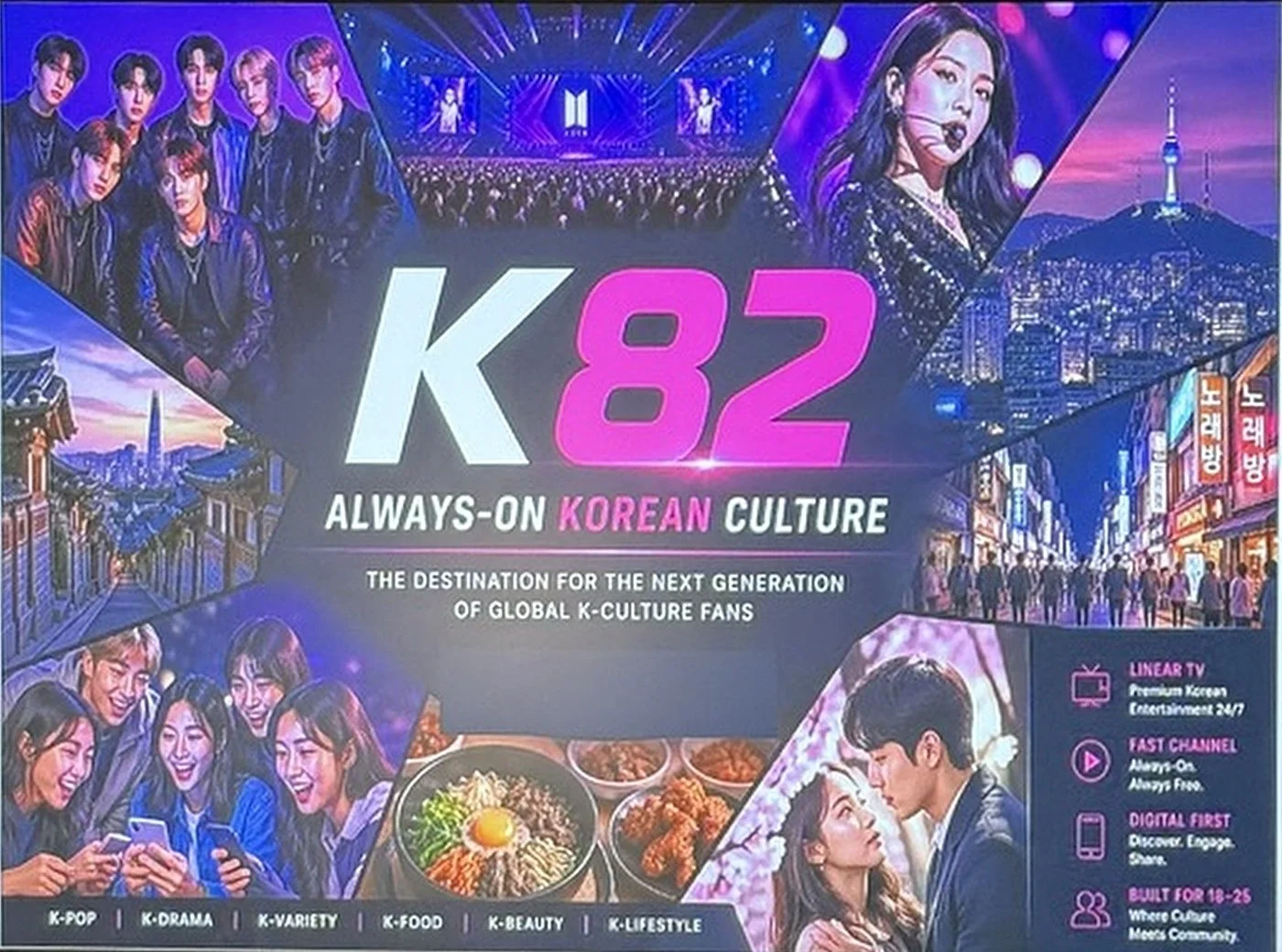
Tucked into a back corner of NAB Show New York last week, I sat in on one of the most unlikely sessions you could imagine.
In my wildest dreams, I never thought I’d hear Del Parks speak as an authority on K-pop and Korean culture.
For anyone who doesn’t know him, Del has been with Sinclair for more than 50 years and leads its technology as President of Technology. He has been one of the driving forces behind the industry’s move to ATSC 3.0, and he’s someone I’ve long respected for thinking a few steps ahead of everyone else.
The session, “Seoul Search: Leveraging ATSC 3.0 and K-Culture to Unlock New Opportunities,” moderated by NAB’s John Clark, turned out to be one of the most eye-opening of the show. Not because of the K-pop, but because of what it revealed about where ATSC 3.0 might finally start making money.
What BEST actually is
For many station groups, ATSC 3.0 still feels like a cost. It means new transmitters, new equipment and a transition timeline that depends on Washington. The FCC has proposed moving the top 55 markets fully to 3.0 by February 2028 and everyone else by 2030, but the industry is still waiting on a final answer.
What I saw in New York was a different way to look at it.
Sinclair calls it Broadcast-Enabled Streaming TV, or BEST, a term coined by Sinclair technology veteran Mark Aitken. The idea is simple. A station uses a small slice of its over-the-air signal to tell NextGen TV sets that a channel exists. Viewers see it in the program guide like any other local station. When they tune in, the video streams over the TV’s internet connection.
That matters more than it might sound. During the transition, one transmitter in a market is often carrying the 3.0 signals for several stations at once, so over-the-air capacity is tight. With BEST, how many services a station can offer is no longer limited by its spectrum.
The guide is the asset
I’ve spent much of my career helping content owners move from satellite to IP, and I’ve written before that the value of IP lies in the options it creates. BEST is that same idea showing up inside broadcast itself.
The over-the-air signal isn’t carrying the programming. It’s carrying discovery.
That is a bigger deal than it looks. Today, a FAST network that wants to reach viewers on a connected TV has to go through whoever owns the screen. Roku, Samsung and others decide where you appear, and they typically take a share of the advertising.
A BEST service sits in the live TV guide next to the local network affiliates, and the broadcaster decides what goes there. It’s also local by nature, which opens the door to local advertising.
It can be a starting point, too. When Sinclair launched Tennis Channel’s T2 this way in 2024, CTO Mike Kralec described connected-TV delivery as an initial path that could eventually lead to full over-the-air carriage.
This is already happening
BEST isn’t a lab demo. Del’s slides listed three services already running in 1080p HDR: T2, Pickleball TV and the interactive music network ROXi.
Public television is part of the story as well. In 2024, Sinclair and America’s Public Television Stations (APTS) agreed that Sinclair would host public stations for free in markets where Sinclair had launched 3.0 and the local public station had not. Nebraska Public Media went live in Omaha that October, followed by Nashville PBS in December and PBS Reno in January 2025.
What caught my attention most is that the model is spreading beyond Sinclair. SiliconDust, the company behind HDHomeRun tuners, now offers stations a turnkey BEST product, complete with viewership analytics. Once vendors start packaging something, it’s no longer one company’s experiment.
Why K82 matters
Which brings me back to K-pop.
In March, Sinclair and KBS, South Korea’s national public broadcaster, announced a partnership to launch K82, a network devoted to Korean culture. Del’s presentation listed K82 as a proposed BEST service, and during the session he noted that a single BEST channel could be distributed across Sinclair’s 160-plus stations.
The audience data Sinclair shared, citing KOCOWA, the U.S. home of KBS, MBC and SBS programming, is striking. U.S. viewers of Korean content are 90 percent non-Korean, 60 percent under 30 and 89 percent female.
That, for me, is the insight. This audience exists in every market but may be too thin in any one of them to justify a scarce broadcast slot. Add those viewers together across a national station footprint, and you have something worth programming and selling.
Sinclair is also building the tools to monetize it, including CTV watermarks to count impressions and shoppable features using IRCODE’s interactive lens technology.
Put those pieces together and the pathways come into focus. Stations gain new business in carriage, revenue sharing, guide placement, local advertising and audience data. Content owners, from niche networks to international broadcasters, gain national linear reach without paying a gatekeeper’s toll.
What still has to be proven
There are open questions.
Today’s audience is limited to households with an antenna, a NextGen TV and an internet connection. Pearl TV says more than 19 million certified NextGen sets have shipped, and figures presented at NAB this spring put roughly 20 percent of U.S. households relying on over-the-air TV for most of their viewing. A new class of converter boxes priced at $60 or less should help widen that base.
Delivery costs also grow with every viewer, as with any streaming service. And until the FCC settles the transition timeline, many stations will keep treating 3.0 as a capital decision.
But I keep coming back to what that session showed.
Sinclair has been ahead of the industry for years, first on IP distribution and now on ATSC 3.0. BEST is the clearest example I’ve seen of how 3.0 can stop being a cost and start being a platform.
K82 is the one to watch.
If you’re thinking about BEST, ATSC 3.0 or new distribution for your content, I’d be glad to compare notes.
Chris Myers
Founder, Chris Myers Consulting
Sources
Sinclair, “Seoul Search: Leveraging ATSC 3.0 and K-Culture to Unlock New Opportunities,” NAB Show New York, October 22, 2026
Sinclair and APTS Announce Free Virtual Channel Hosting for Public Television Stations, Business Wire, March 2024
Sinclair Adds Tennis Channel’s T2 to NextGen TV Broadcasts, TV Tech, March 2024
Korean broadcaster to partner with Sinclair on NextGen TV channel, The Desk, March 2026
ATSC Offers Free ATSC 3.0 Guide to 2026 NAB Show, TV Tech, April 2026
Pearl TV Makes Major Progress Toward Affordable NEXTGEN TV Converter Boxes, SVG, October 2026
NextGen TV Update From NAB 2026, TWICE, April 2026
BEST Channels: The Killer App That Could Finally Fulfill NextGen TV’s Promise, TVREV, 2025